
The Essentials in Five Lines
LIP is a French brand founded in Besançon in 1867. The watches are designed, assembled, adjusted, and inspected there, and the dials bear the LIP Besançon France hallmark. However, the movements come primarily from Japan or Switzerland, except since April 2025, when the brand introduced its own in-house caliber, the R26. Of the 285 LIP models in our catalog, 143 are quartz and 48 are automatic. Fifteen models are currently available for order, ranging in price from 188.89 to 1,986 euros.
This is the question that comes up every time we talk about LIP, and no one answers it frankly: Is it still a French watch? The honest answer is twofold. Yes, for the brand, the design, and the assembly. No, for the movement—almost never.
This isn't just a minor detail, because it's exactly what the buyer thinks they're purchasing. Here's what's really happening in Besançon, why this brand is significant in the history of global watchmaking, and which collection to choose based on what you're looking for.
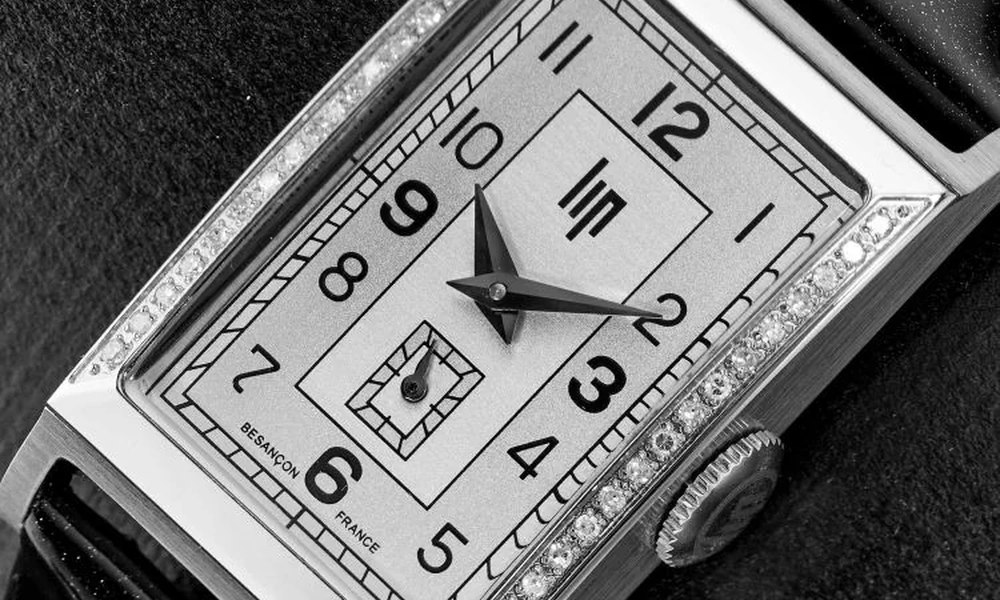
The T18's dial bears the inscription "Besançon, France." This applies to the case and the assembly, not the movement.
Is LIP still a French watch brand?
LIP is now owned by a French family-run business. The design, prototyping, assembly, adjustment, and final inspection are all carried out in workshops near Besançon, in the Doubs department. The watches bear the “Made in France” mark, and the “LIP Besançon France” hallmark is engraved on the dials, as can be seen on the T18 above.
The movement, however, comes from elsewhere. Depending on the model, it’s either a Japanese Miyota or a Swiss Sellita. And that’s not a flaw—quite the opposite: a proven Swiss caliber remains the best guarantee of reliability and serviceability you can put in a watch, and French watchmakers openly acknowledge this. Michel Herbelin puts it bluntly: out of tens of thousands of watches produced each year, reliability comes from tried-and-true Swiss calibers.
So this isn’t unique to LIP: virtually all French brands do the same, because mass production of movements has ceased in France since the quartz crisis. What has changed is that in April 2025, LIP unveiled its first in-house movement in thirty years, the R26 caliber, developed in collaboration with the SupMicroTech engineering school in Besançon. This is a first step, not yet the norm.
Key takeaway: A LIP is French in terms of the brand, the design, and the assembly, but not in terms of the movement—except for the very latest models equipped with the R26. If this is important to you, the question to ask isn’t about the brand’s nationality but that of the caliber.
1867, Besançon, and the watch that Churchill acquired
The story begins in 1867, when Emmanuel Lipmann, a member of an Alsatian family of watchmakers, founded the Comptoir Lipmann in Besançon. At the time, the city was the watchmaking capital of France, and would remain so for a long time.
The T18 caliber, starting in 1935
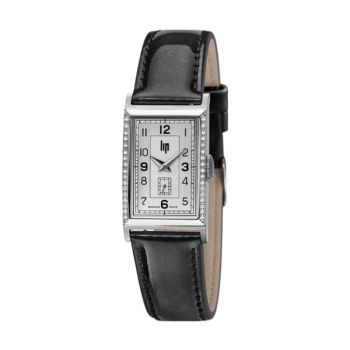
Production of the Type 18 rectangular caliber began in 1935, just before the war. It was this movement that would establish the brand’s reputation, and the rectangular case that would become its signature. Even today, the Churchill collection features 37 models in our catalog, making it the second-largest collection after the Himalaya.
1948, the watch given to Churchill
In 1948, the French government presented Winston Churchill with a gold-plated T18 as a token of gratitude for the British role during World War II. The name has remained part of the collection. It is by far the most sought-after LIP: the corresponding search term alone generates several thousand searches each month.
LIP
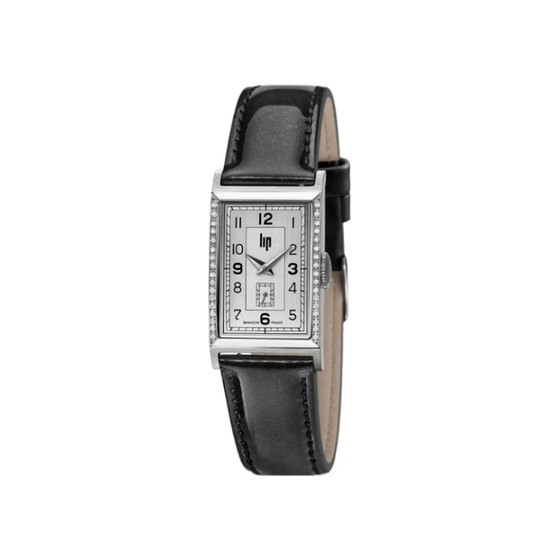
T18 Churchill Diamond
Quartz, 21 mm case, black leather
The 1935 Art Deco rectangle watch, set with gemstones, featuring the Besançon, France hallmark on the dial.
668,89 €
LIP
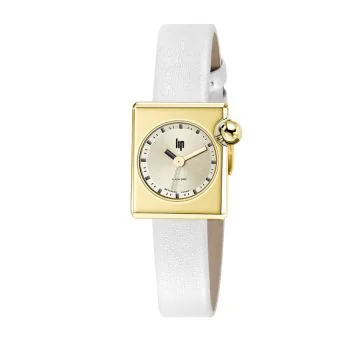
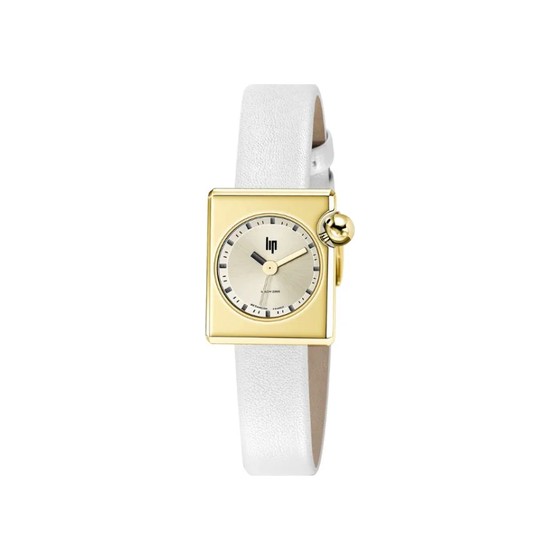
Mach 2000 Mini Square
Quartz, 30 mm case, white leather
Roger Tallon's "Carre" in a small size, with a gold-plated dial. The entry-level model in the catalog.
188,89 €
In 1952, LIP invented the electric watch, beating everyone else to it
On March 19, 1952, LIP unveiled the world’s first electric watch, powered by the R27 caliber. A more advanced version was released on December 7, 1958. The movement ran on two micro-batteries, and the research team added a diode designed to capture the sparks produced each time the balance wheel made contact.
One was given to General de Gaulle, and another to General Eisenhower. The watch would come to be known as the “presidents’ watch.”
The irony is absolute, and that’s what makes this brand so interesting. LIP paved the way for electric watchmaking sixteen years before Japanese quartz took the entire French watch industry by storm. The company that had invented the future was swept away by it. And today, of our 285 LIP models, 143 are quartz.
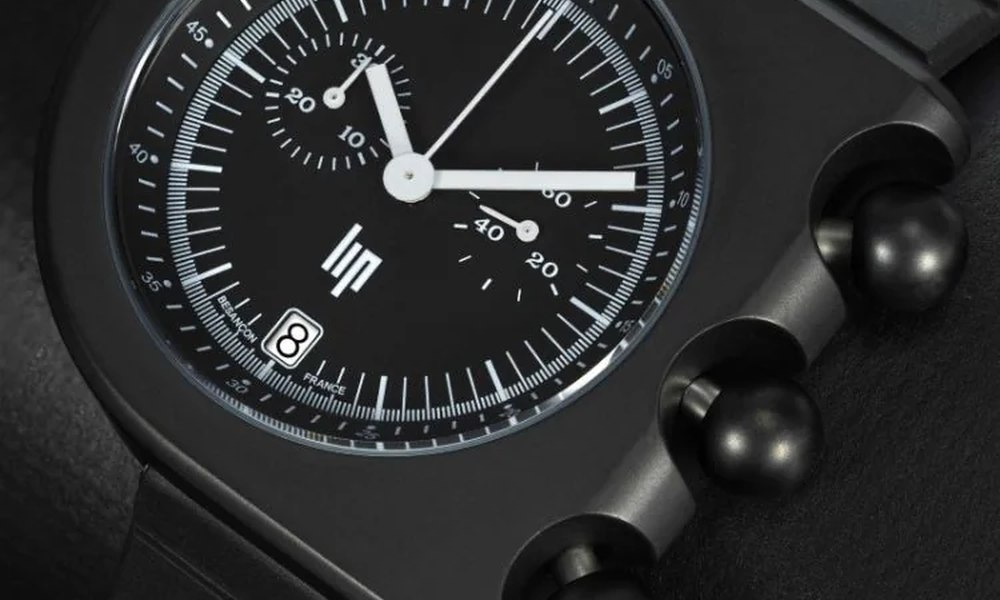
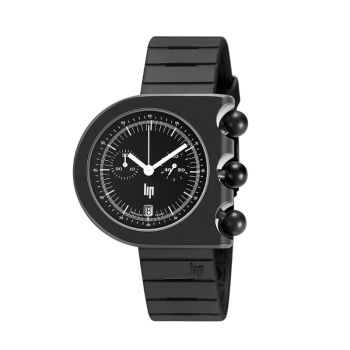
The spherical pushers designed by Roger Tallon—the brand's most recognizable signature.
1974: Designers who came from elsewhere only to leave again
After the labor dispute of 1973, which made the Besançon factory famous far beyond the world of watchmaking, LIP called upon a group of designers from outside the industry to revamp its collections. Among them were Roger Tallon, Jean Dinh Van, Marc Held, Isabelle Hebey, and François de Baschmakoff.
Roger Tallon's Mach 2000
Roger Tallon is the industrial designer behind the TGV Atlantique and the Montmartre funicular. In 1975, he designed a watch conceived first and foremost for ergonomics, featuring colorful spherical pushers and a case that looks like nothing else. His collaboration with LIP lasted until 1996 and resulted in more than twenty models. The Mach 2000 remains the brand’s most recognizable piece, with 28 references in our catalog.
LIP
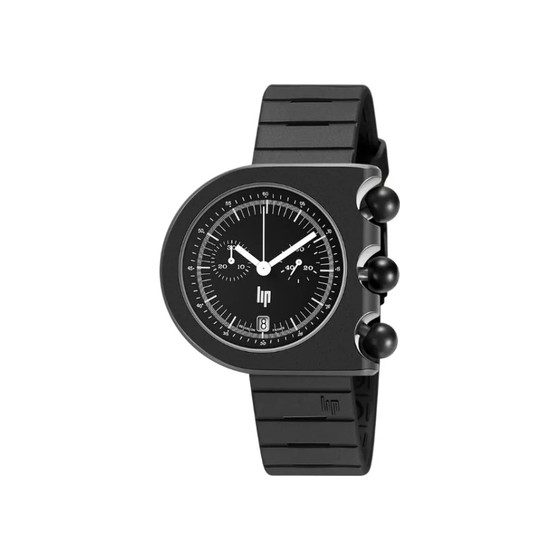
Mach 2000 Moon Dark Master
Quartz, chronograph, 42 mm case
The all-black version of the 1975 design, with its spherical pushers.
448,89 €
LIP
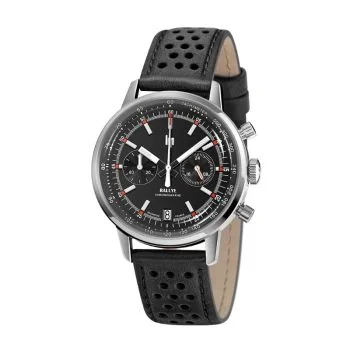
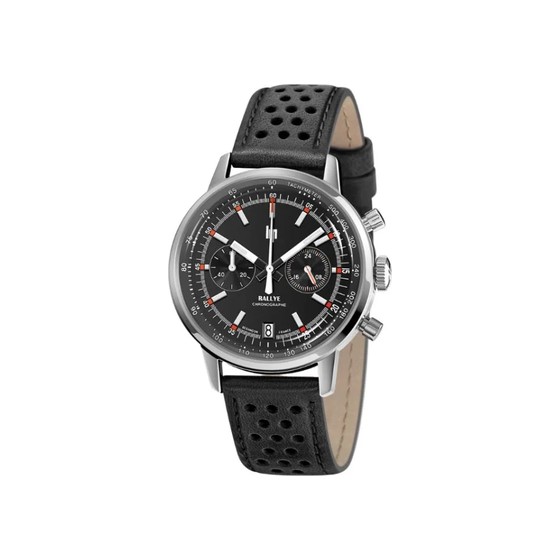
Rallye 39 mm Chronograph
Quartz, 39 mm case, black dial
The automotive-inspired chronograph, which is quartz-powered and therefore requires no mechanical maintenance.
298,89 €
Which LIP collection should you choose?
The LIP collections are not distinguished by their level of craftsmanship or price range, but primarily by the shape of the case. So that's where we should start.
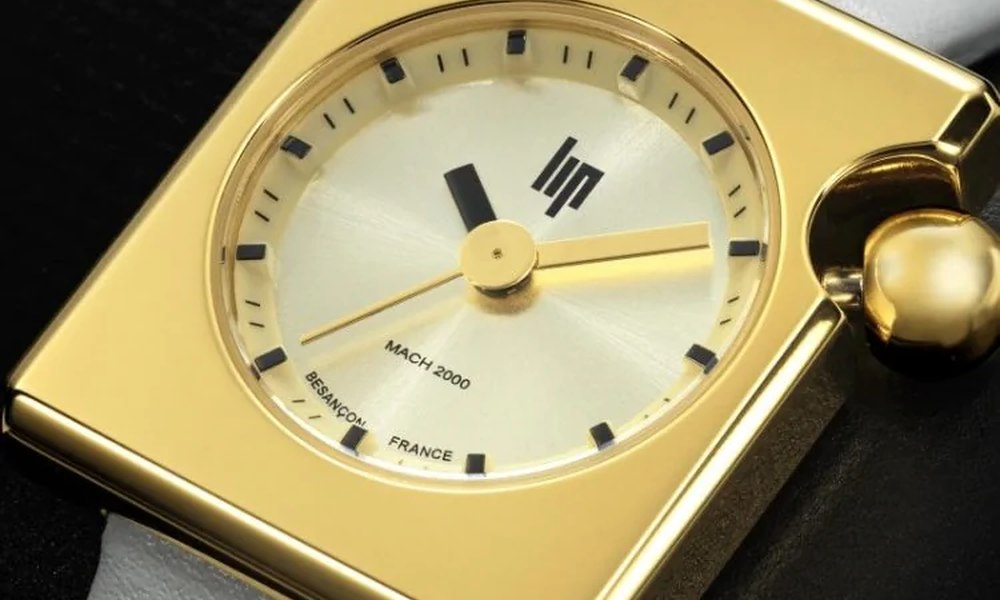
The Mach 2000 Mini Square: Roger Tallon's design scaled down to 30 mm, for slender wrists.
Churchill T18: The Rectangle
The rectangular Art Deco case, a direct legacy of the 1935 caliber. This is the LIP to wear with a dress shirt. 37 models in the catalog, most of them quartz. See the Churchill T18.
Mach 2000: 1970s Design
Roger Tallon's square watch with spherical pushers is available in a Mini Square version for smaller wrists and as a chronograph for everyone else. Twenty-eight models, all part of the Mach 2000 collection.
Himalayas: the most abundant
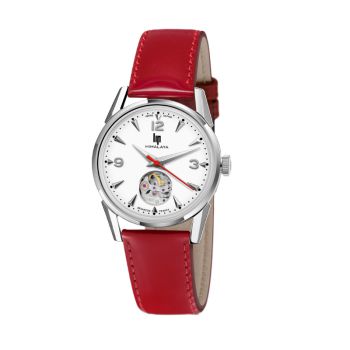
The Classic Round collection, the largest in the lineup with 60 models, is one of the few to offer automatic watches, including open-heart versions with exposed movements. The collection is available in 35 mm and 40 mm sizes.
Nautic: The Diver
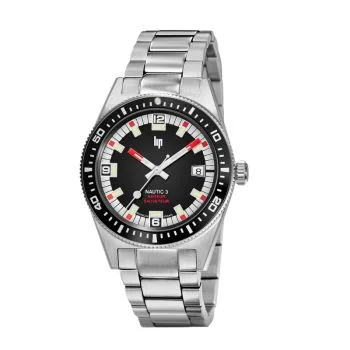
Dive case, rotating bezel, automatic movement. This is the most technically advanced LIP model, and the only one to significantly exceed water resistance standards: across the entire catalog, only 12 models reach 200 meters. See the Nautic Ski models.
Rally: The Chronograph
The automotive world and the chronograph: available in quartz for 298.89 euros or in automatic for over 1,500 euros. See the Rallye collection.
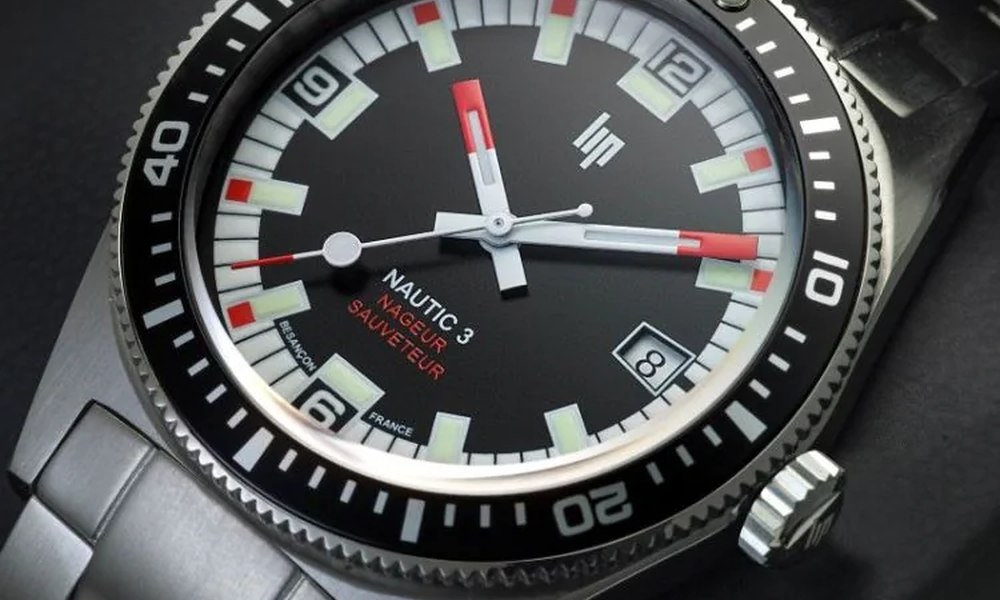
The Nautic 3: Across the entire LIP catalog, only twelve models are rated to 200 meters.
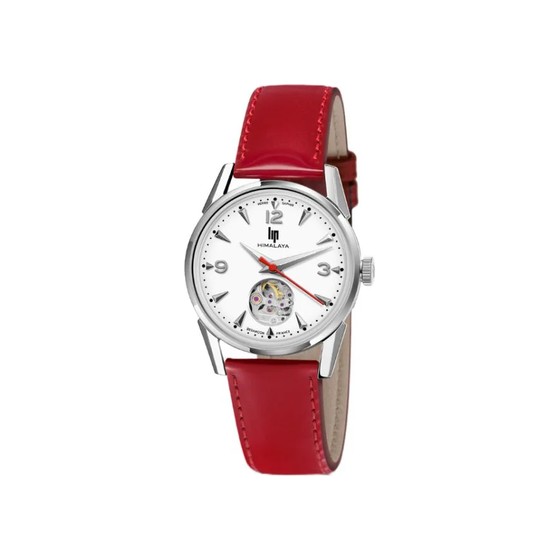
LIP
Himalaya 33 mm Automatic
Automatic, beating heart, 33 mm
Open dial revealing the balance wheel. One of the brand's few affordable automatic watches.
428,89 €
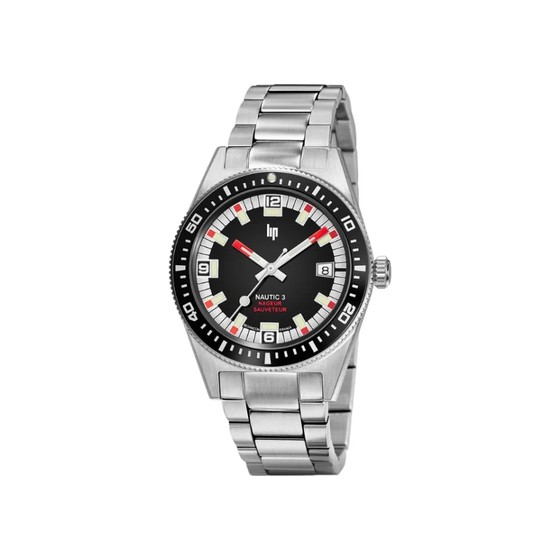
LIP
Nautic 3 Lifeguard
Automatic, 39 mm, rotating bezel
The "Diver" figurine, reissued based on lifeguard models.
1198,89 €
Quartz or automatic? The number that makes the difference
This is where most buyers end up in the wrong section. LIP’s image is that of a traditional French mechanical watchmaker, but the catalog tells a different story: 143 quartz models, 48 automatic models, and 4 hand-wound mechanical models. Four out of five watches are not mechanical.
It’s not a flaw—it’s a design choice. Quartz allows the brand to keep prices between 150 and 400 euros for cases designed and assembled in France. But if you’re looking for an automatic watch, you should focus specifically on the Himalaya, the Nautic 3, or the Rallye 42 mm—and accept the shift in product line that comes with it. All of our automatic watches, including LIP models, are grouped together in one place. On that note, our guide to automatic watches explains what difference the mechanism really makes in everyday life.
The bracelet: the cheapest way to get into LIP
It’s the entry-level line that no one pays attention to. LIP straps start at 20 euros for leather or rubber, go up to 30 euros for the De Baschmakoff line—named after the designer hired in 1974—and reach 40 euros for Milanese mesh. They can be attached to a LIP just like any other watch with compatible lugs, which also makes them a great way to change the look of a watch you already own.
The key measurement to check is the lug-to-lug width—that is, the distance between the lugs of the case. The LIP collection ranges from 8 mm to 35 mm, which is unusually wide, and both the Mach 2000 and the Diode lines require specific widths. Our watch size guide provides detailed measurements.
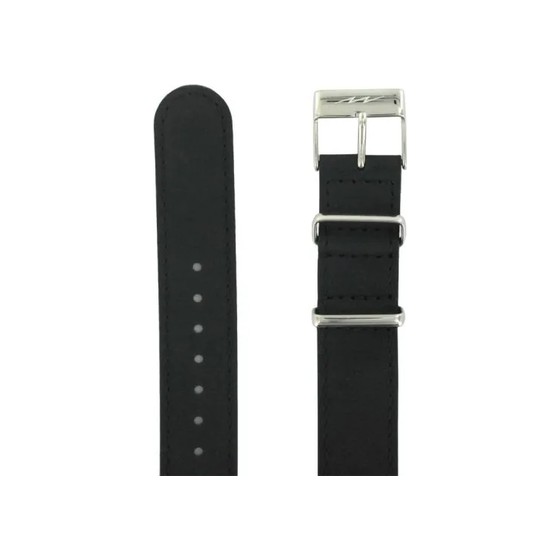
LIP
Black leather NATO-style wristband
Leather, 18 mm between the horns
LIP's absolute entry-level model, and an easy way to switch out a watch.
20 €
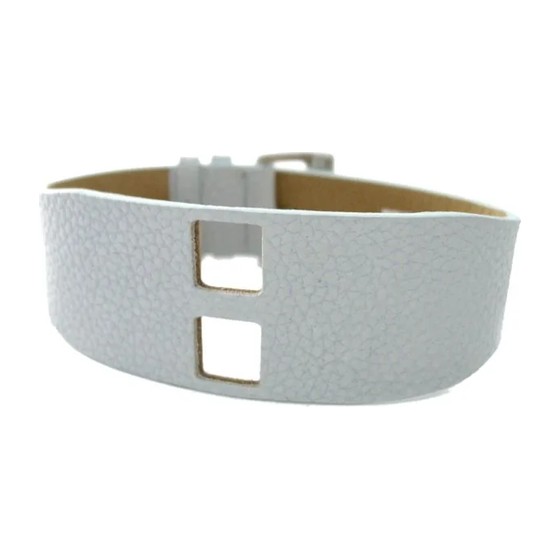
LIP
De Baschmakoff Blue Leather Bracelet
Leather, 32 mm between the horns
The line named after one of the designers hired by the brand in 1974.
30 €
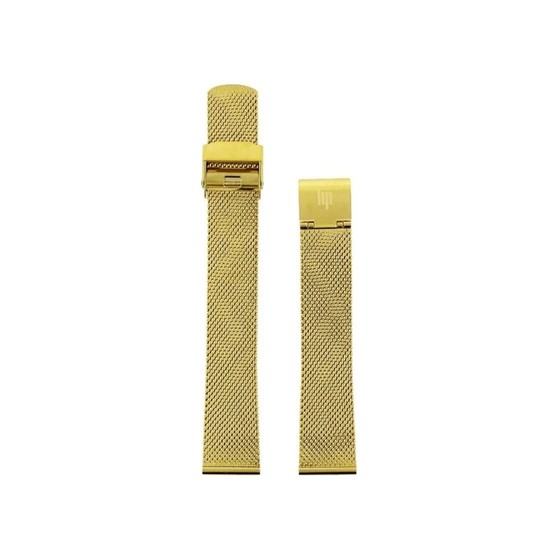
LIP
Gold-plated Milanese-link bracelet
Mesh steel, 18 mm between lugs
The gold Milanese mesh, to give a classic watch case a dressier look.
40 €
What You Need to Know Before Buying
The LIP catalog is extensive on paper but limited in reality. Of the 285 active models, only fifteen watches are currently available for order, and most are limited to one or two pieces. The collections change, the series come to an end, and a model listed one month may be gone the next.
In practical terms, this means two things. If you like a model and it’s available, it won’t stay that way for long. And if you’re looking for a specific item you’ve seen elsewhere, it’s better to write to us than to wait for it to come back in stock. The pages for the LIP collection and LIP bracelets are updated continuously.
If the LIP you're looking for is no longer available
This is the most common scenario, and it’s better to mention it up front rather than let the customer find out when placing an order. Three other French brands make exactly the same promise, with the same original guidelines: designed and assembled in France, with Swiss or Japanese movements.
Michel Herbelin has been based in Charquemont since 1947, assembles and inspects every watch in France, and fits Swiss ETA, Ronda, and Sellita movements. Charlie Paris, founded in Paris in 2014, holds the “Entreprise du Patrimoine Vivant” (Living Heritage Company) designation, assembles its watches in Besançon like LIP, and uses Japanese Miyota and Seiko movements or Swiss Soprod and La Joux-Perret movements. Kelton takes a different approach, focusing on colorful designs and competitive pricing.
The real advantage over LIP right now is quite simple: they have items in stock. Here is a comparison, collection by collection.
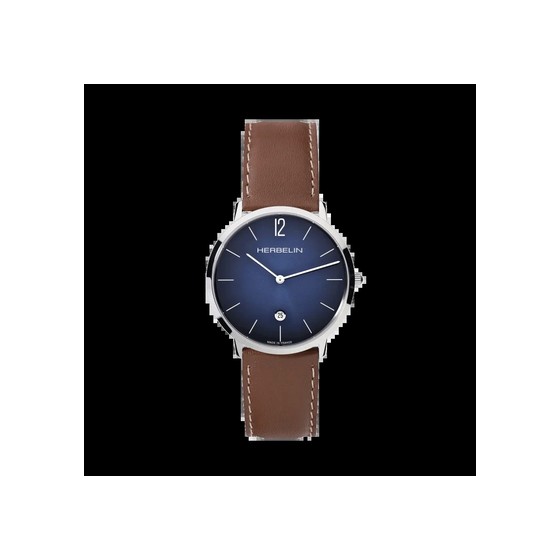
Michel Herbelin
City Quartz Blue
Swiss quartz, steel, and brown leather
Replacing the Churchill T18: the French-built model, assembled in Charquemont.
299,89 €
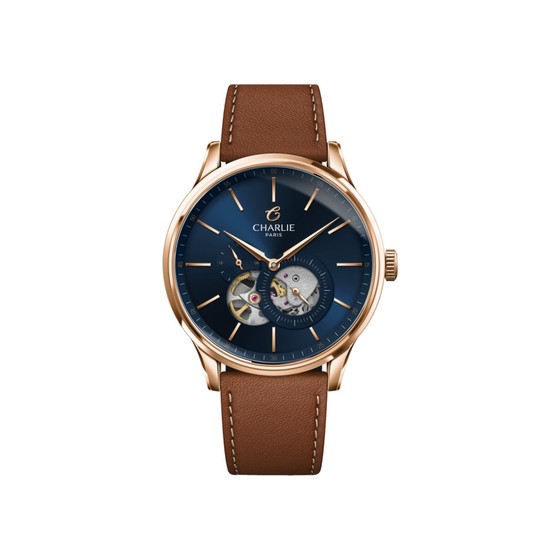
Charlie Paris
INITIAL Open Heart
Miyota automatic movement, open dial
Instead of the Himalaya Coeur Battant: the same open dial revealing the balance wheel.
445 €
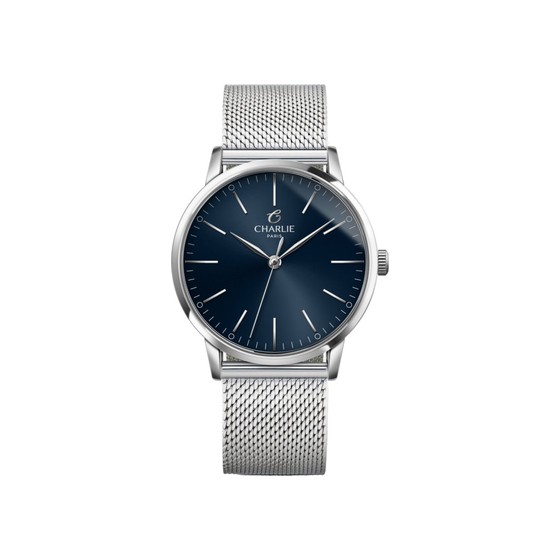
Charlie Paris
SULLY 35 Steel & Blue
Quartz, 35 mm, stainless steel
Instead of an entry-level round LIP, which is also assembled in Besançon.
145 €
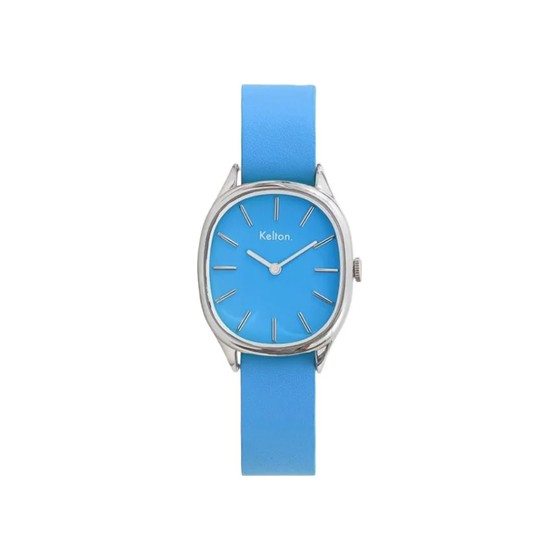
Kelton
Blue Colorama
Quartz, colored case
Instead of the Mach 2000: the colored drawing card, at a much lower price.
120,25 €
To put LIP in context within the French watch industry, our guide to French watches compares the various brands, and the vintage watch guide helps you understand a vintage timepiece—which is often the gateway to this brand.
Frequently Asked Questions
Are LIP watches made in France?
Partly. LIP is owned by a French family-run business, and the design, assembly, adjustment, and final inspection are carried out near Besançon, in the Doubs department. The dials bear the LIP Besançon France hallmark. However, the movements are mostly Japanese—Miyota—or Swiss—Sellita. Since April 2025, the company has once again produced its own in-house caliber, the R26.
What is the difference between the T18 and the Churchill?
None; these are two ways of referring to the same family. T18 refers to the Type 18 rectangular caliber, production of which began in 1935. "Churchill" comes from the watch presented to Winston Churchill in 1948 by the French government. Today, the Churchill collection features this rectangular case, with 37 models in our catalog.
Did LIP really invent the electric watch?
Yes. On March 19, 1952, LIP unveiled the world’s first electric watch, equipped with the R27 caliber. A fully developed version went on sale on December 7, 1958. One was presented to General de Gaulle and another to General Eisenhower, earning it the nickname “the presidents’ watch.”
Which LIP collection should you choose to get started?
The Mach 2000 Mini Square is the most affordable entry-level model in the catalog, priced at 188.89 euros. For a classic rectangular case, choose the Churchill T18. For an automatic watch, choose the Himalaya or the Nautic 3. The real deciding factor is the shape of the case, because LIP collections are distinguished first and foremost by their design.
Is a LIP quartz or automatic?
Quartz in the vast majority of cases. Of the 285 active LIP models in our catalog, 143 are quartz, 48 are automatic, and 4 are manual-winding mechanical watches. Anyone looking for a French mechanical watch should therefore specifically consider the Himalaya, the Nautic, or the Rallye automatic.
How much does a LIP watch cost?
The models available for order today range from 188.89 euros for a Mach 2000 Mini Square to 1,986 euros for a Rallye 42 mm Grand Prix de France Historique or a limited-edition T18 Original. The core of the lineup is priced between 300 and 700 euros.
Who designed the Mach 2000?
Roger Tallon, a French industrial designer known for the TGV Atlantique and the Montmartre funicular. He was one of the designers from outside the watchmaking industry whom LIP brought on board in 1974, and he designed the Mach 2000 in 1975. His collaboration with the brand lasted until 1996 and resulted in more than twenty models.
Can I buy a LIP bracelet on its own?
Yes, and it's the most affordable way to get a LIP watch. The brand's straps start at 20 euros for leather or rubber, 30 euros for the De Baschmakoff line, and 40 euros for Milanese mesh. They fit on a LIP watch just as they do on any other watch with compatible lug spacing.